Another Moog Enters the Conversation
While Bob Moog informs Houston's foundation, we continue to take lessons from another engineer in the Moog family
To our surprise, it is now two engineers named “Moog” that inform this framework’s narrative in some way or other. Robert Moog built the synthesizers that brought the family name into the music industry lexicon. Houston Haynes, designer of this framework, its language, and its type system, began his career as Bob’s student and later helped him restart the company that once again made “Moog Music” as an international brand. And now, it also gains some perspective from William (Bill) Moog, Bob’s cousin, who founded the motion-control company in East Aurora, New York in 1951. His electrohydraulic servo valve and by extension that company became a fixture of precision control in avionics and aerospace. The two sides of that family story connected just recently. Houston encountered the company’s published engineering in the course of separate research after this framework’s design had taken shape. By extension, this entry is about control and precision: one lesson taught in a classroom, and a later recognition found in print.
Houston’s time in Bob’s shop covered a wide variety of hardware and software engineering, including high-frequency analog circuit work and, later, wired cascading interrupt structures across Zilog processors along with flipping hex codes in EEPROMs to change an instrument’s behavior. But before that Houston was one of Bob’s students at the University of North Carolina at Asheville. One seminal lesson that started in those classes, with Bob in the role of research professor, stands out above others. It points to how engineering answers can be found in sound mathematics.
The Ring Modulator Lesson
A ring modulator’s signal path runs through transformers, filters, and lines whose behavior over time is governed by the Telegrapher’s equations. For a voltage :
The equation is precise and, at a workbench, unusable: in the time domain there is no practical route from that PDE to the capacitor rating the circuit needs.
Euler’s formula changes the domain rather than the physics. Electrical engineers have worked in the resulting phasor domain since Charles Steinmetz introduced the method for alternating-current analysis in the 1890s. In the case of a ring modulator, the opening assumption is that carrier and modulator signals are sinusoidal, so substitute . The derivative of is , so differentiation becomes multiplication by , the calculus collapses into algebra, and the capacitor’s full behavior reduces to a complex impedance:
In this domain the component values “fall out” of the equations. The series capacitor that blocks DC at the input follows from : with a input impedance and a cutoff,
and a workbench with a decent array of components would provide a standard film part. The parallel capacitor that shorts a carrier leak to ground follows from the same relation with a cutoff near , which puts the part between and ceramic. What started as an exercise in esoteric mathematics yields a garden-variety component search.
| Role | Placement | Governing algebra | Selected part |
|---|---|---|---|
| DC blocking | Series with input | , , | film |
| Carrier-leak damping | Parallel to ground | Same relation, against a carrier | to ceramic |
The same algebra explains what the instrument does to the ear. A ring modulator is a four-quadrant multiplier, and multiplying two cosines runs Euler’s formula in the other direction:
Both source frequencies vanish from the output. Only their sums and differences remain. The mathematics suppresses the carrier completely. The diode ring does not, which is why the second capacitor in the table exists. Feed the circuit harmonically rich sources and every harmonic pairs with the carrier into bands that are no longer harmonically related. The phase terms, carried in the imaginary component of each product, set how those bands beat against one another. That interaction is why a ring modulator sounds so much richer than its parts, and why, with judicious amplitude shaping of carrier and modulator, a convincing “gong” tone emerges from very simple waveforms.
The difference terms carry one more effect, and it is the one that most enriched the calculation when Houston worked these spectra by hand. When a modulator harmonic exceeds the carrier, the difference frequency computes to a negative number. No real output holds a negative frequency.
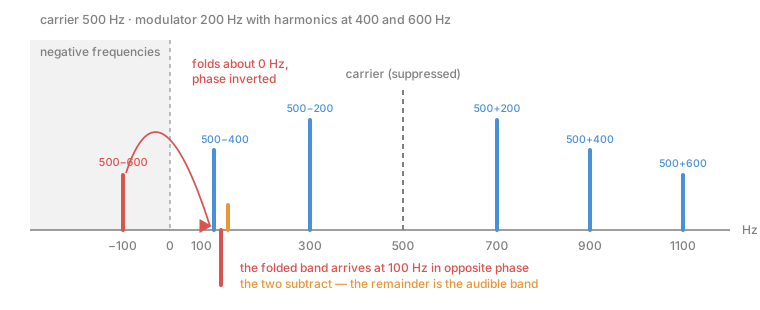
The band folds back across into the audible range, and the fold inverts its phase. A folded band can land directly on a band that is already there and add to it in opposite phase. In the figure above, the third harmonic’s difference term computes to and folds back onto the band the second harmonic already produced. The orange band shows what remains after the two combine.
The principle has much greater range as an object lesson than the blackboard session, and is the reason Houston retells the story. The PDE and the algebra describe the same circuit. In one representation the answer is unreachable at any reasonable approach. In the other it falls out figuratively speaking, carrying as sound anyone would recognize, and a mathematical derivation any engineer can use for part selection.

The Other Moog
In a generationally parallel history, Bill Moog’s servo valve turned milliamps of electrical signal into precisely metered hydraulic force, with feedback closing the loop inside the device itself, and that component made high-authority flight control practical. The company grew into a fixture of precision motion control across aerospace: aircraft flight surfaces, launch vehicle steering, and spacecraft actuation. What Houston found, decades after the bench years in Bob’s shop, spans two generations of the company’s published engineering: the servo-valve transfer-function bulletins, and the digital-thread program it documents today.
The first generation is the servo-valve literature, and its centerpiece is Transfer Functions for Moog Servovalves, Technical Bulletin 103, written by W. J. Thayer in 1958 and revised in 1965. The bulletin taught control engineers to work with the valve as a frequency-domain transfer function, and for most system design a first-order approximation served:
Flow per unit of drive current , a flow gain , and a single time constant : enough algebra to size a control loop in a way similar to how the ring modulator algebra sized a capacitor. Where a design pressed closer to the valve’s dynamics, the bulletins supplied the second-order form, with damping ratio and natural frequency stated per valve family:
Substitute and this is the ring modulator lesson again: differential equations exchanged for algebra, with each approximation’s range of validity stated so a customer’s engineer could check every derivation before the valve ever moved a flight surface. We take the deeper precedent from the practice itself: a component vendor publishing checkable mathematical models of its own products.
The transfer function becomes part of the product, and independent verification becomes standard practice.
The lesson here runs deep. Moog (the Aircraft Group) has a storied history sufficient to shine a light on several generations of engineering design: paper travelers, then MRP in the 1970s and 80s, then ERP through the 1990s and 2000s, then product-lifecycle management, then digitized shop-floor execution. Each system holds authority over something real: PLM is the design, MES is the build record, ERP is the digital ledger. Run separately, the three systems assign the same physical part three different numbers. The divergence stays invisible until a mismatch puts the wrong part in an assembly. This is the object lesson that we found sympathetic to the Fidelity Framework’s posture.
Moog’s aerospace business publicly documents how it threaded them. Teamcenter, the as-designed authority, synchronizes to Solumina execution systems in the US and UK and to SAP S/4HANA on the ERP side. What crosses between systems is identity and linkage: parts and EBOM references, change orders, quality clauses, document links, and trade-compliance attribution. The identities are held in an Object-Relationship Store, the bulk data never moves, and each system remains authoritative for its own records. The integration deployed in months with no components installed into the endpoint systems, and because the identifiers survive, the thread is rebuildable. Over such a spine, configuration states can line up as effectivity-dated baselines: as-designed, as-planned, as-built, as-maintained, and most importantly as-flown.
  flowchart TB
    TC["Teamcenter (PLM)<br/>as-designed authority"]
    SOL["Solumina (MES, US & UK)<br/>as-built authority"]
    SAP["SAP S/4HANA (ERP)<br/>enterprise authority"]
    ORS["Object-Relationship Store<br/>identities and linkages only"]
    TC --- ORS
    SOL --- ORS
    SAP --- ORS
The director of product-lifecycle management for Moog Aircraft Group presented its framing, end-to-end traceability as an element of company transformation, at CIMdata’s PLM Road Map in May 2023, and a Moog PLM architect presents the Aerospace & Defense PLM Action Group’s digital-twin and digital-thread benchmark on the group’s behalf, whose catalog of eighty use cases published in 2026 with twenty-eight demonstrated against commercially available software.
The curious reader may note what engages the thread alongside the part numbers: trade-compliance attribution, the export-control dimension carried as first-class identity.
From valve dynamics in to configuration identity spanning as-designed to as-flown, the discipline is continuous across seventy years: choose the representation in which the answer can be verified objectively, keep one authoritative identity for every fact, and publish enough of the model that an independent engineer can check it. From the workbench, Houston found Bob’s high regard for his cousin easy to understand. It is the same standard, held at two scales.
The Tractable Domain
One of these lessons shows up directly in Fidelity’s foundation. Clef’s dimensional types descend from Andrew Kennedy’s units of measure, and our published type system work keeps that algebra in fragments with the phasor domain’s character: dimensional consistency is exact integer arithmetic over an abelian group, value ranges propagate as interval algebra through the compiler’s program graph, and the verification tiers are drawn so a solver decides the everyday obligations quickly and unattended.
That is the Euler substitution made permanent.
The mathematics was placed, deliberately, where answers ‘fall out’, and the tooling is being built so they arrive at design time, supportive of the developer’s goals. Our commitments were set before Houston ever read Moog’s digital-thread documentation: BAREWire holds both sides of every boundary to one checked contract, and the certificate design attaches a labeled derivation to every discharged obligation. What the compiler asserts stays checkable by engineers, by toolchains, and in time, by auditors.
The aim behind those commitments is the same territory the other Moog company serves. Our Fidelity Framework is built for the hardware-software boundary: Clef compiles through Composer to processors, FPGAs, and NPUs, the substrate of complex control systems where software meters physical properties. Systems in that territory are governed by DO-178C in avionics and by sibling designations across regulated industries, and adherence is part of the framework’s original design goals. Certification practice accepts two kinds of evidence, qualified-tool verdicts and machine-checked proofs. Our “tiered proof” certificate establishes which trusted base stands behind each claim. A compliance package assembled from an ordinary build in the Fidelity Framework would have the option to speak to either or both representations as needed.
Finding the same commitments, independently, in the published practice of Bill Moog’s company is the kind of confirmation an engineer trusts precisely because it emerges from sympathetic principle. We are gratified that our own path found the adjacency, and the companion entry on our Braidpoint site, The French Connection, follows the surrounding evidence tradition through the certification tooling regulators have trusted for decades.
Houston took the standard from one Moog in person and, decades later, found it again in the other’s company history. We are building this framework to hold that standard: precision in complex domains, verification that carries integrity, and identity held such that the next engineer, or the next system, can verify and trust the work.